
The End of The Ice Age: Ice Doesn’t Heal Injuries, it Delays Them.
- antoniowilliams72
- Jul 18
- 6 min read

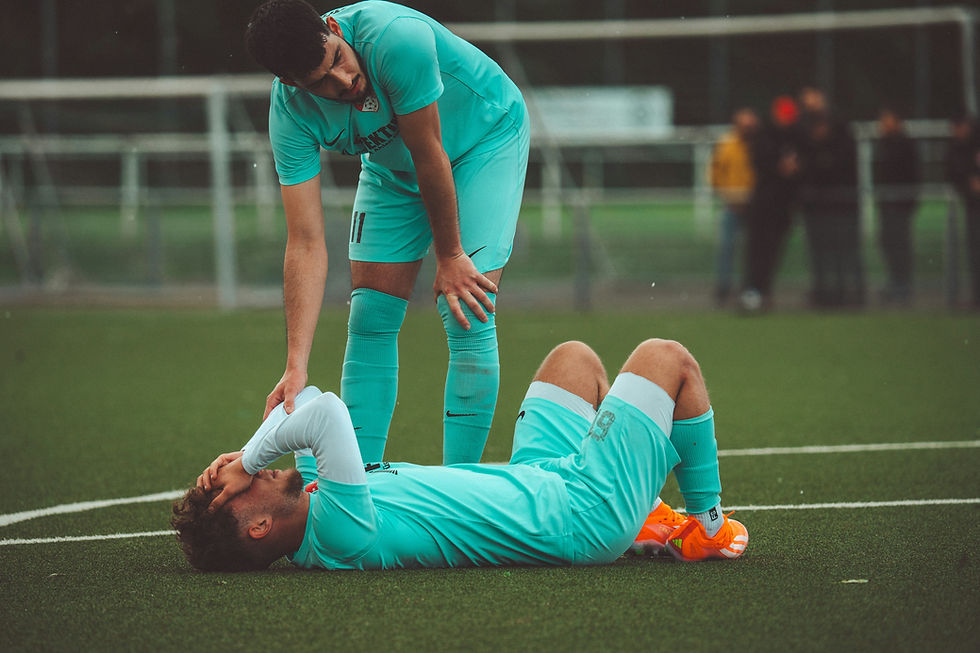
August of 2021 I was at a youth football game in Pittsburgh, Pa (same place as the 2026 NFL Draft) standing on the sidelines watching the Wilkinsburg Bees play the Southside Bears. Like many sporting events, there was an injury during the game. When the player was brought over to the sidelines, he was in visible pain. I saw two women come over who introduced themselves as nurses and pulled out ice packs for the players ankle injury. In typical fashion after an injury they were going to apply the ice packs and suggest that he get off of his feet and elevate them to help with the injury.
I sat and observed a common mistake when dealing with injuries, the nurses were using the R.I.C.E method. R.I.C.E stands for:
Rest- Ice- Compression- Elevation
This is what most people were taught is the most effective way to help a person recover from an injury. The only problem is, there was never any evidence to suggest that the R.I.C.E method helped to speed the return to play after an injury. Actually, using the R.I.C.E method can delay healing. The R.I.C.E method disrupts mechanotransduction and oxygenation of the injured muscles. That may sound like a lot, but I will explain what that means here shortly, but mechanotransduction is key when focusing on fast injury recovery. Besides that statement, the inventor of the R.I.C.E method actually recanted his statement in 2015 stating that ice and rest can hurt, instead of helping injuries.
Although the creator of the R.I.C.E method recanted his statement, many healthcare professionals (athletic trainers, doctors, physical therapist) coaches, and parents still use ice as a “go to” for injury recovery.
Here is how the R.I.C.E method was started. May 23rd, 1962 Boston, Massachusetts a young 12 year old Everette Knowles was “train hopping” and had an unfortunate situation where he severed his arm. At this time there was no successful limb reattachments in the world, so if a limb was severed, then it was lost forever. On this 23rd day of May in 1962 the world was changed forever by this injury. Everette was taken to Massachusetts General Hospital in Boston, where 12 physicians completed the first ever successful limb reattachment.
Word of this successful limb reattachment traveled fast across the world. News reporters interviewed the physicians, and one of the main components that allowed this to be a successful limb reattachment was putting the severed limb on ice to help preserve the arm until surgery. The reporters thought explaining surgery process may be too complicated for their readers, so the reporters focused on the part about icing the limb. That’s when the use of ice became a global phenomenon for injury recovery. Everyone started talking about the wonders of ice.
In 1978 Dr. Gabe Mirkin coined the term R.I.C.E. For the past 40 years every professional, coach, parent, and athlete has learned to use ice and rest injuries. Unfortunately, this injury recovery method has hindered and delayed the return to play for athletes. As mentioned before, there was never any evidence to suggest this recovery method worked, which is one of the reasons why Dr. Mirkin recanted his statement in 2015. I want coaches to understand that you cannot have an old way of thinking, this is literally hurting your athletes. In 2026 there are several new injury recovery strategies that can be used in place of R.I.C.E
P.R.I.C.E- Protection, Rest, Ice, Compression, Elevation
P.E.A.C.E & L.O.V.E. – Protection, Elevation, Avoid Anti Inflammatory, Compression,
Education & Load, Optimism, Vascularization, Exercise
M.E.A.T- Movement, Exercise, Analgesics, Treatment
P.O.L.I.C.E- Protection, Optimal, Loading, Ice, Compression, Elevation
Let’s look at injuries when a person gets hurt; there is trauma to that area and they lose flexibility, strength, range of motion, and they develop adhesions (scar tissue) around that injured limb. After an injury, scar tissue develops. Scar tissue is your bodies biological response to injury to help immobilize that joint and protect it so healing can occur. Here’s the main problem with ice and rest, ice gives a numbing sensation and pain relief to the injured area. But what does an injury need to heal? It needs blood flow to heal the injury, clear the old dead cells and debris. Therefore the two main components of the R.I.C.E method are working against the healing process.
Of the new injury recovery strategies I have seen, the M.E.A.T method has worked wonders in quickly returning athletes to the sport. Going back to the beginning story about the athlete who I saw injured at the youth football game. I told the nurses that were coming with the ice packs for the injured athlete, that I had a different injury recovery strategy that I want to implement. I got the athlete active, moving, stretching, and pushing through the pain. It took about 20-30 minutes for the recovery workout, by the end of the session he was fine and felt no pain. In fact, not only did he go back into the game, but he scored a touchdown to help his team.
I was able to help the athlete return to the game faster with the use of the M.E.A.T method vs the R.I.C.E method. This is why I said “M.E.A.T over R.I.C.E” in the opening title. The Ottawa ankle rules state that if you were unsure if you should take an athlete with a rolled ankle to the hospital for x rays to confirm if there was a broken bone, you could perform this test. If an athlete can take 4 weight bearing steps, no matter how bad the pain or hobble, as long as they could take 4 steps without any assistance there is over a 90% chance that the bone is not broken. The rule was created because there was a high amount of x rays for rolled ankles and majority of the x rays came back negative for rolled ankles. This was a huge cost of healthcare bills for the hospital, insurance company, and parent. Part of the Ottawa ankle rules explained that many times an athlete did not have a broken bone and could actually walk on the ankle if they were given encouragement to do so by the treating physician.
The use of the M.E.A.T method is how I helped over 100+ athletes recover from injuries and get to the point where they had little to no pain because the athletes did not rest or use ice, but they were active.
Movement increases blood flow and promotes healing. There will be pain with movement following an injury, but athletes need to understand there are two different types of pains. One pain is felt instantly, sidelines, and hurts to move. The other pain is uncomfortable, but bearable. This pain usually will go away shortly after moving. This is the basis of the M.E.A.T concept. The main contributor to accelerate healing is strength restoration. If the muscle is weak then you can not return to play. Muscular strength is a test that also needs to be factored in returning to sport. In order to restore strength, mechnotransduction must happen. This is a missing piece of the R.I.C.E method and why the M.E.A.T method works so well. Mechnotransduction is the biochemical response in the body to stimulate tissue repair, regeneration, and remodeling.
In conclusion, movement, strength training, and exercises helps to create a mechanotransduction process to being the healing process. Rest and ice actively works against this process, which is probably one of the reasons Dr. Mirkin may have recanted his statement that ice and rest helps with recovery. The use of M.E.A.T principles is rooted in the belief that early and controlled mechanical loading (movement & exercise) will start the process of repair and remodeling tissue sooner than R.I.C.E principle focused on immobilization.
The R.I.C.E method disrupts mechanotransduction and oxygenation of the muscles with the primary focus of rest. Mechanotransduction and mobilization bridges the gap between injury and tissue repair. So I think it’s safe to say, get active after an injury.
Scialoia, D., & Swartzendruber, A. J. (2020). The R.I.C.E. protocol is a myth: A review and recommendations. The Sport Journal.
Nakamichi R, Asahara H, (2024). The role of mechanotransduction in tendon, Journal of Bone and Mineral Research, https://doi.org/10.1093/jbmr/zjae074
Horschig, A., Sonthana, K., Williams, B., Horgan, M., & Starrett, K. (2024). The efficacy of icing for injuries and recovery: A clinical commentary. Journal of Contemporary Chiropractic, 7(1), 96–101.
Kwiecien, S. Y. (2023). Is it the end of the ice age? International Journal of Sports Physical Therapy, 18(3), 547–550. https://doi.org/10.26603/001c.74273
Comments